Many Moons
Efraín López, NYC
September 9 – November 1, 2025
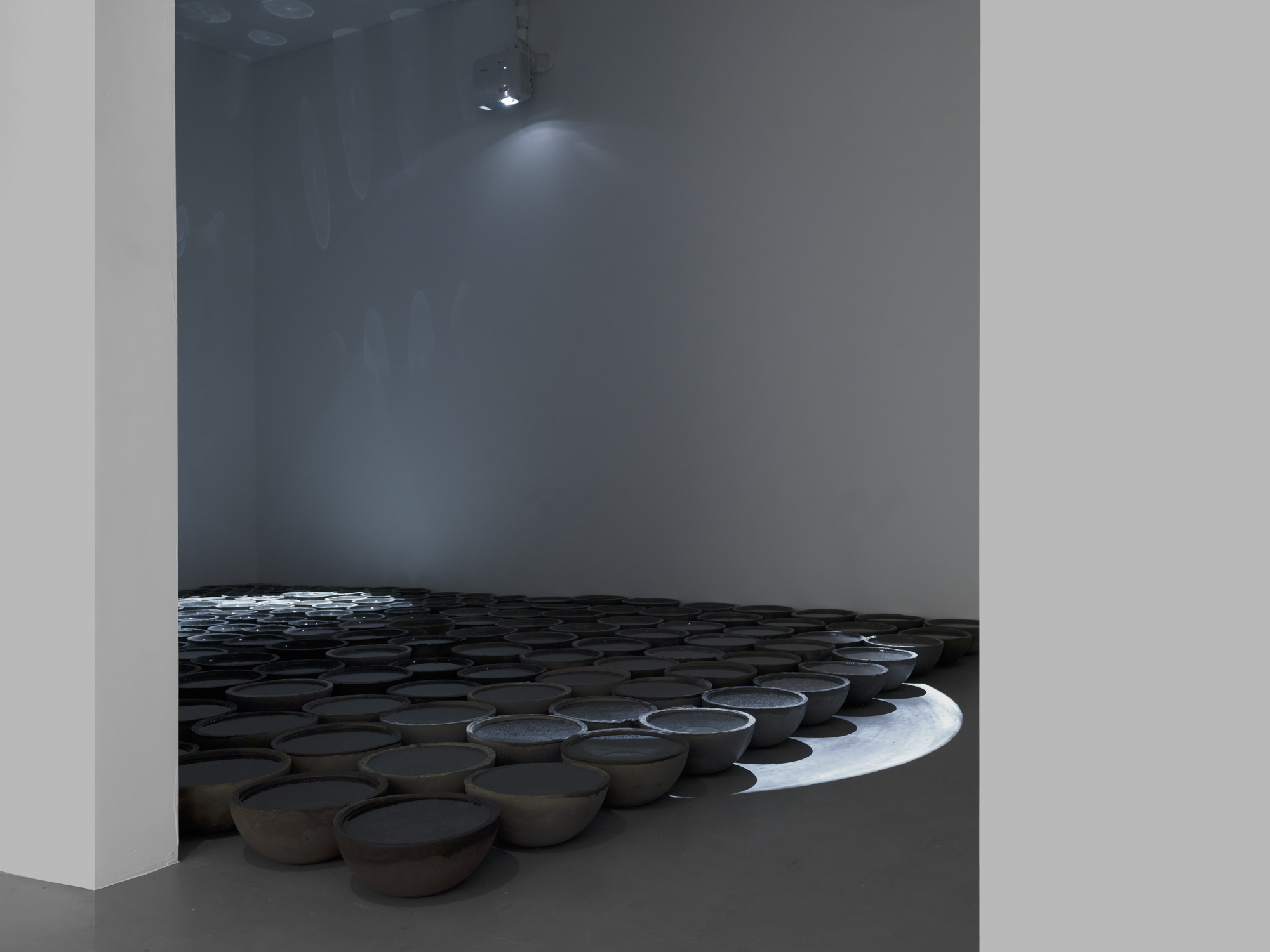
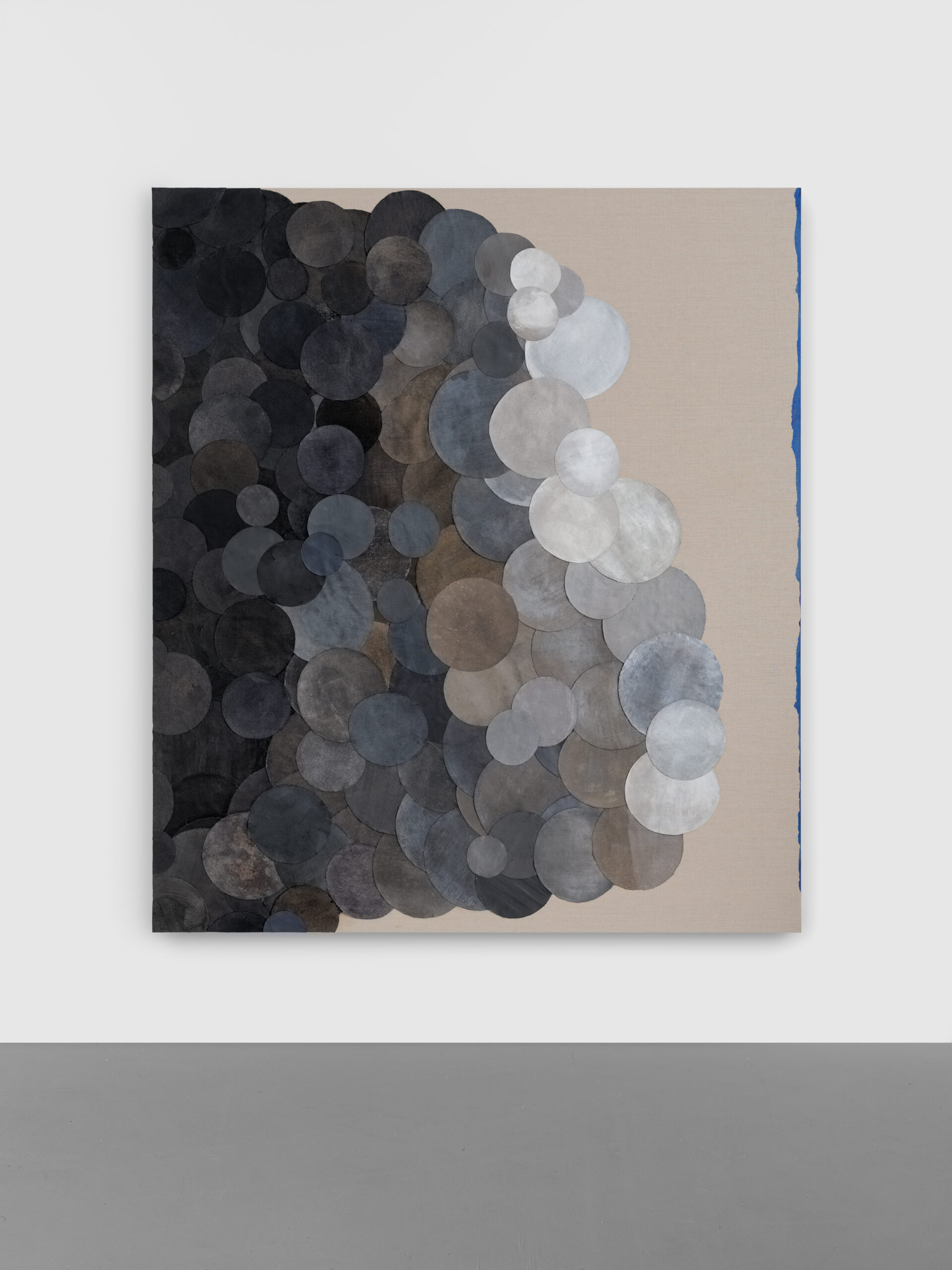
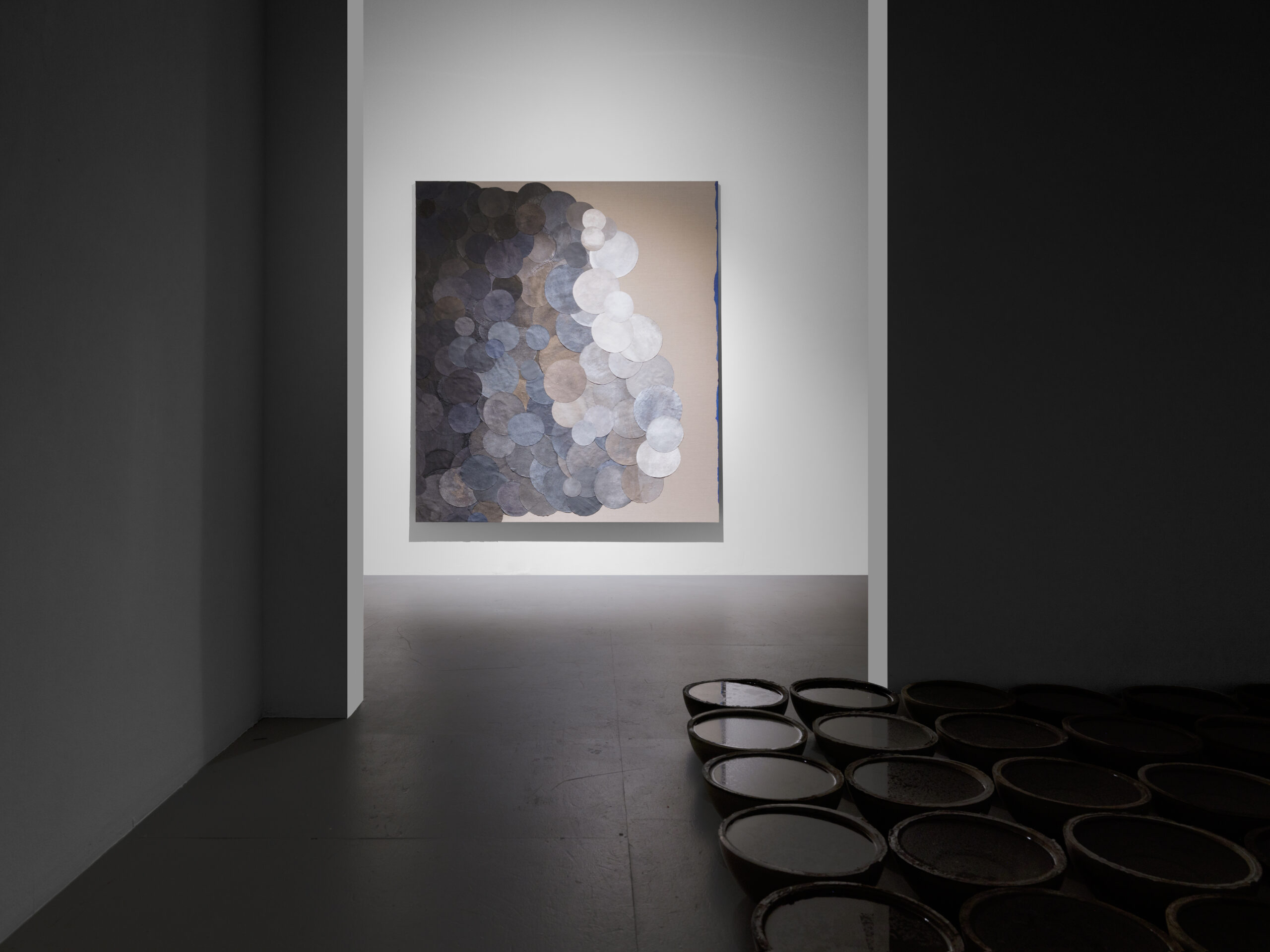
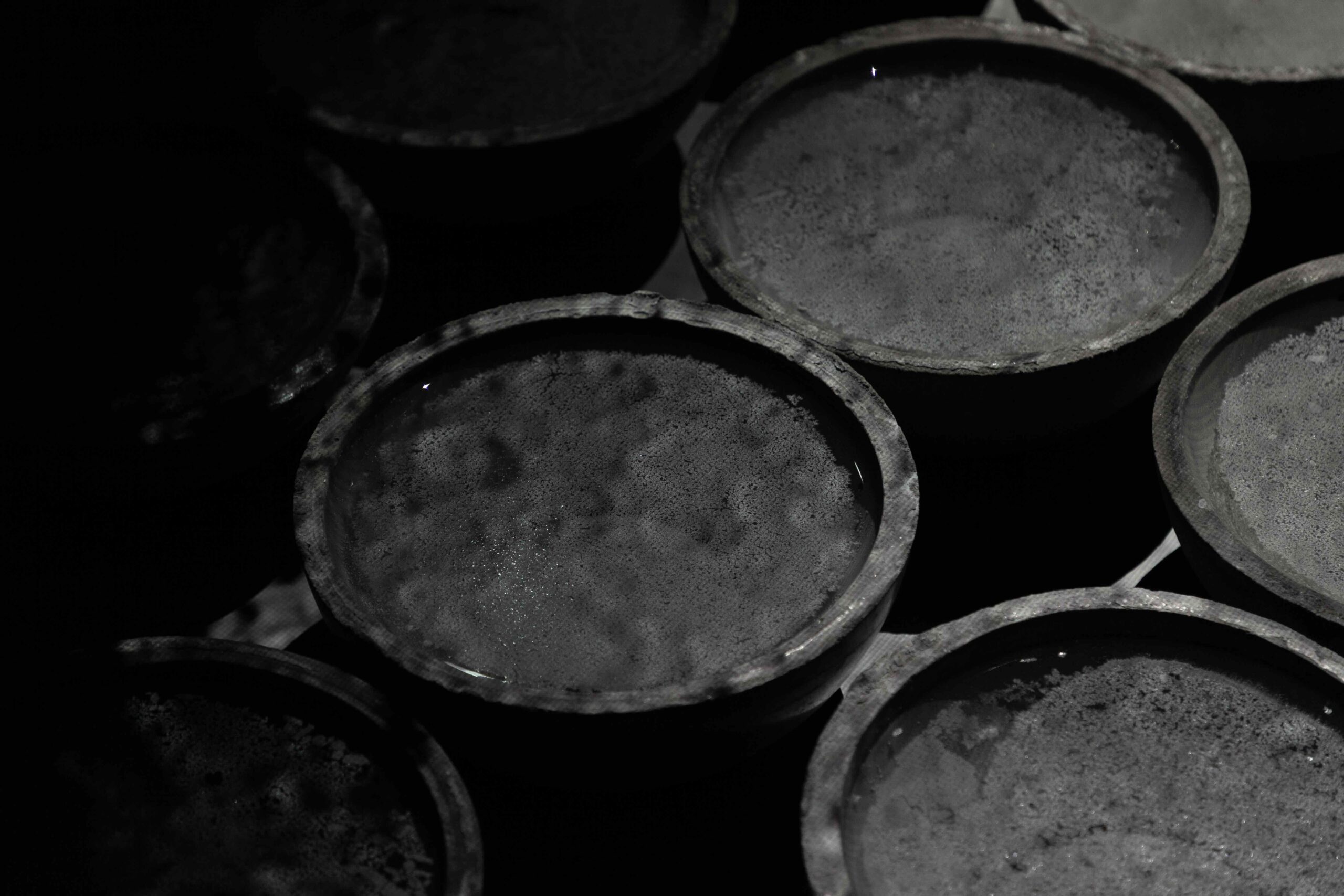
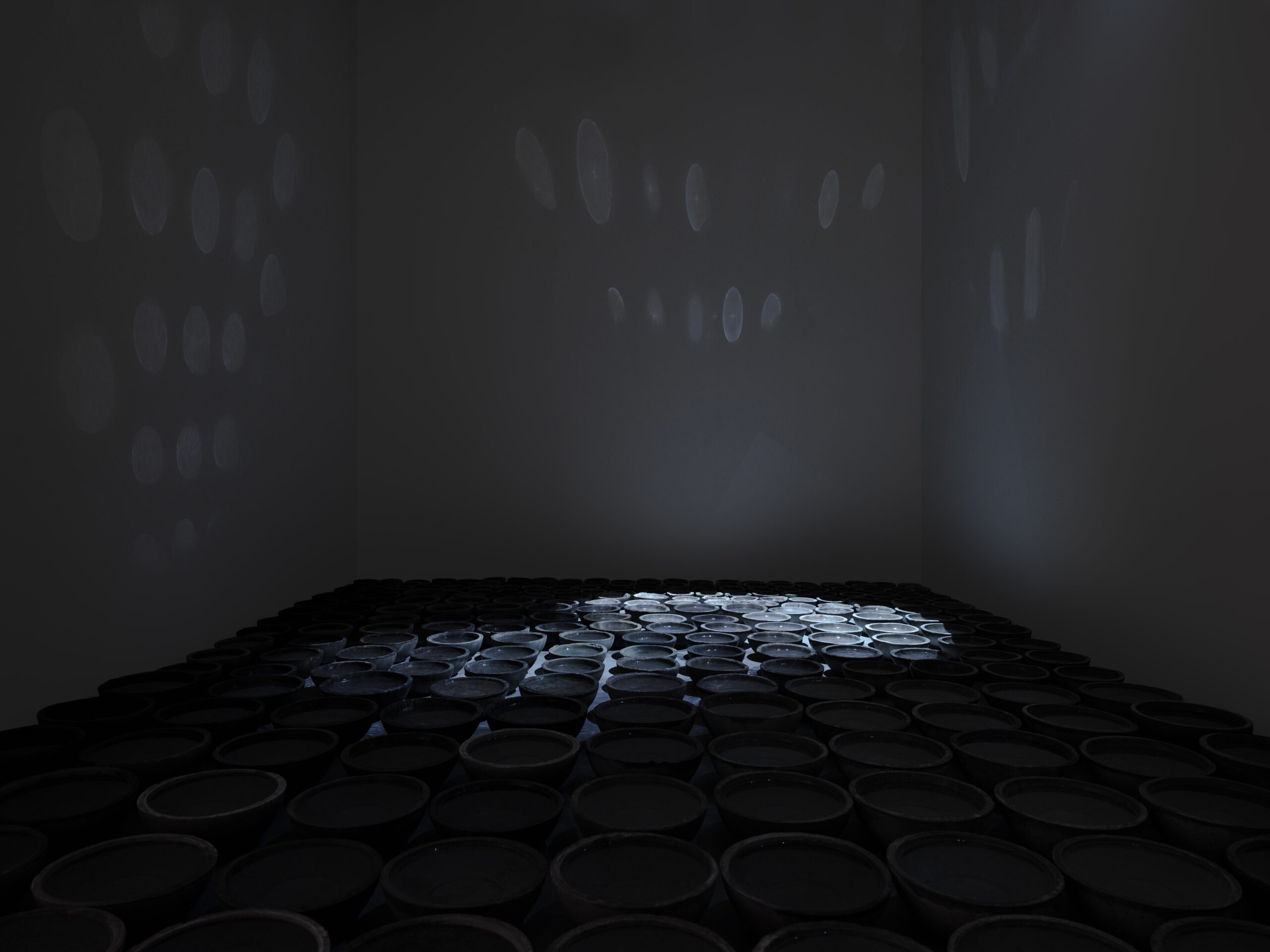
Efraín López proudly presents Many Moons, a solo exhibition featuring new works by Jen DeNike. This exhibition marks her first collaboration with the gallery and follows the premiere of her film, Prelude at The Museum of Modern Art New York. On view from September 5 to October 18, 2025, the exhibition features a time-based sculptural installation of concrete bowls, video, and sound, presented alongside her first large scale painted collage. Together these works explore layered materiality and evoke both physical and ephemeral feminine embodiments of the moon. DeNike’s post-minimalist sound score features abstracted recordings of her voice, created in collaboration with composer Zack Di Lello.
Libration Points
On Jen DeNike’s Many Moons
by Andrew Berardini
Here, the light of many moons breathe on bodies of water, a flicker of the celestial gleaming across their skin. Drawn from time, a woman’s voice tells stories and litanies names that echo and whisper over the bowls holding presence. She speaks with a resonance like solace. This is Jen DeNike’s Many Moons.
Downstairs in the darkness of Efraín López, DeNike grids out over 300 hand-cast concrete bowls, graded in their color from gray to black, each filled with water. From wall to wall, they break for a walkway peering onto their circular reflections. Over time, the water evaporates, marking lines in the concrete, though periodically refilled. Projected lunar sequences derived from NASA’s Dial-a-Moon spin and shimmer over the water while a sound work lets a woman’s voice, name-saying and storytelling, fill the room, held softly by electronic tones. So much of this, and the spatial logic behind it, is cut into a linen collage of layered circles, Waxing Gibbous for Sally.
The star of our show, of course, is the Moon, and all the women marking time and direction through space on her rotations.
The Moon, this luminous spaceship caught always in locked revolution against the Earth, her cool gray radiance reflecting the Sun’s hot white heat. She measures that uncontrolled blaze of incandescent plasma with her rotational reveries. She draws tides and trajectories, the celestial body whose gravity plots our capsules’ arcs, and the feminine force steadying the hands of women who steer them.
The tidal queen, the chaste mistress, the keeper of secrets. An ancient, feminine force, the lustrous light of the Moon shines with the ceaseless rhythm of ancient oceans, her glow ponderous, ruminative and unfathomable. For women who train and fly, she is a cosmic sister and guide, her phases shadowing mission calendars and long nights in the simulator. From Valentina Tereshkova to Sally Ride to Mae Jemison, she has been a compass for women who slip Earth’s hold and learn the silence of orbit.
Though tidally locked to us, she will never be ours. Her silvery light never generative, only reflective. Not our mother, but another woman we cannot live without. Her powerful pull midwives, all living things.
It doesn’t matter that a handful of astronauts set their boots on her surface. (Not yet a woman’s boot, though that promise keeps circling.) We can poke her with flags and rove her over and over, but we are powerless to possess her beauty, to diminish her celestial force. Half hidden from prying eyes, she keeps a darkness we can witness only as darkness, unborn but still new, a mystery telescoping scientists may inspect with lunar orbiters but, struck with meteors and settled by waterless seas, she reveals only so much of her countenance to us on Earth. For the women who look up, suit up, and strap in, she is not a conquest but a companion—astral elder, compass, mirror.
—
The many moons have been summoned here by artist and filmmaker Jen DeNike. A lightworker, she’s interested in how humans decipher and understand the edges of the known. Whether through literature, ballet, or astronauts, DeNike explores female bodies moving through space, creating and tracing their choreographies alongside the elemental forces they move with and against. Full of joy and shaped through emotional minimalisms, her subjects are shaped by many mythologies, feminist and gendered. Working across a multitude of media she’s taken a significant turn here toward expanding sculptural installation collaged with moving image.
When I asked DeNike who shaped the work in Many Moons, she didn’t hesitate. “Eva Hesse, top of the list. Nancy Holt. Hannah Wilke. Agnes Martin,” she said, “I would put on Many Moons.” These artists form an asterism, constellations astride in the night sky. Not a poetic aside, but wayfinding—guiding the structure, material, and philosophy of the work.
Many Moons isn’t just a sculptural installation—it’s a study in perception, repetition, and feminine embodiment. DeNike spoke of Eva Hesse’s forms as “the skin of the works,” circling around repetition and abstraction that still hold something tactile, vulnerable, bodily. “There’s something of the body in all of their work that is so innately feminine, yet strong, a force of nature,” she said. “And that’s what this piece is for me.”
With Nancy Holt, it’s about portals and perspective. “She created these portals. It was all about seeing and perspective.” DeNike recalled encountering Holt’s lesser-known works—circles of lamplight in a dark room—and how powerfully they shaped her thinking around sculpting light, like the sun tunnels, the circular light—calibrations of sight for a body traveling through the dark.
Wilke’s influence arrives through gesture, repetition, and video. Sometimes abstracted but always holding a body. For DeNike, this shared attention to form and performance—across video, sculpture, and the everyday—echoes in Many Moons’ combination of projection, sound, and tactile material.
And then there is Agnes Martin. “She’s in my head,” Jen told me. “The repetition of the work, the lines of the notebook, the light, the ephemerality, the depth.” A quiet force. A rhythm. A way of making presence through stillness. Her measured lines hum like trajectories—patient paths through airless space. These are not references; they are ingredients.
She summons a gravity through a repetitive collaged installations of visceral layering. This is the lineage the piece calls into the room. Not as citation, but invocation.
–
Moons rising and setting, waxing and waning here mark time, not as a clock but as a body.
Dates shape these choreographies. DeNike keys each sequence to a ledger moving between public and private—women’s launches into space alongside the artist’s own calendar: her own birthday, her mother’s and her collaborators’, her niece’s (the same as my daughter’s), an Oxford milestone (where DeNike is currently a doctoral researcher), a recent full Moon on August 9. The frames are stretched or tightened, added and subtracted, until the Moon’s libration reads as breath—a wobble that makes time feel feminized and irregular.
Sound makes the space speak. Finalized in the studio, it carries her list of names as litany. Stories about the Moon and the bowls and bodies on the beach, with meanderings slipping in and out of intermittent ambient tones, suffusing it all with memory, poetry, the warp and weave of dreams.
Along one wall a large linen collage, Waxing Gibbous for Sally, holds the project in fabric. DeNike has been cutting up the linen and painting monochromatic circles, then composing them into the abstracted figure of a waxing gibbous moon. The title names a phase and a history, June 18, 1983, when Sally Ride became the first American woman in space.
The installation fills the gallery from wall to wall with a narrow path through. Projections overlap as our Moon becomes many, time collapsing into chorus. The water wetly mirrors its evaporation marking lines in the bowls as the piece progresses. These reflections drift across the ceiling and pause when the room goes quiet. Many Moons is a calendar made of bowls and light, a field of temporal public and private rotations. It doesn’t track the Moon so much as let the Moon track our presences, our absences, the nights we keep.
Then the names return, not as a list but as breath: Valentina, Sally, Mae, Ruth, mothers and daughters, collaborators and strangers. Each syllable ripples a bowl. Each ripple meets a projection and becomes a small eclipse. What we witness is not only astronomy but care: a choreography of tending, of filling and refilling, of evaporation and return. Reflected in the waters of lakes and rivers, puddles and seas, her waxing and waning a cosmic poetry none of us can truly ignore, a light, a body marking time.
Andrew Berardini is a writer out of Los Angeles. An Artforum contributor since 2006, he is the author of Relics (2015) and Colors (2023), a literary atlas of 110 shades of color, shifting through memory, sensation, and art history. He co-curated Kris Lemsalu’s Estonian Pavilion at the 58th Venice Biennale, orchestrated Bruce Nauman’s first-ever skywriting, performed as the Public Writer at Pierre Huyghe’s LACMA retrospective, and has organized exhibitions at MOCA, Palais de Tokyo, and Castello di Rivoli. His writing has appeared in Mousse, Purple, and BOMB, as well as for SFMOMA, the Whitney Biennial, and documenta 14. Berardini is Editor-in-Chief of Art Bae Agenda, a longtime faculty member at the Mountain School of Arts, and a recipient of the Creative Capital / Warhol Grant for Art Writers. His collected writings about LA are forthcoming next year. Often disabled by illness, he bends art writing into poetic reverie—language as tender, strange, and alive.